
ALTER: Residual Denoising Enables Sample-Efficient
Multi-Agent Coordination on Demand
University of California, Berkeley
Overview
ALTER: Adaptation from Limited demonstrations for Team coordination with Existing-skill Retention.
We adapt pretrained single-arm diffusion policies to multi-agent tasks using limited collaborative demonstrations, without access to the original training data. The adapted policy coordinates when deployed in a team while retaining the ability to act independently. Execution is decentralized: each robot acts only on its own visual observations, without explicit inter-agent communication.
Residual coordination adapter
Frozen base policyKeep the pretrained denoiser fixed during adaptation.
Residual adaptationLearn corrections for multi-agent coordination.
Policy-distilled replayRetain source-task behavior using rollouts of the frozen policy.
Technical details
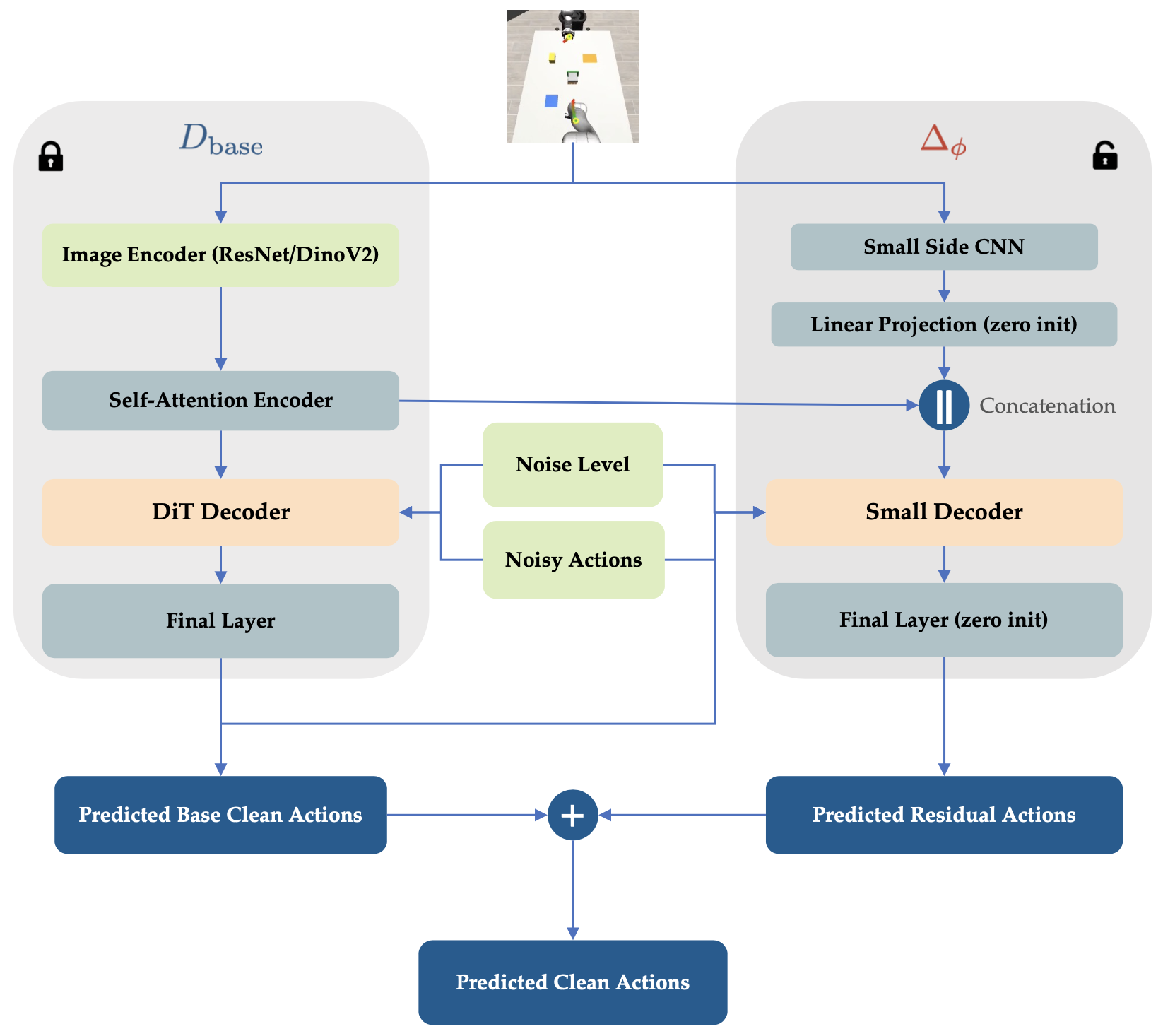
Residual denoising. The adapter receives the noised action chunk, noise level, local observation, and base prediction. Its visual conditioning combines frozen base-encoder features with a lightweight convolutional network. We zero-initialize its output pathway, so adaptation starts from the base policy.
Training objective. We jointly train the adapter on collaborative demonstrations and policy-distilled replay. The coordination loss applies denoising regression to the adapted denoiser; the replay loss penalizes the residual on source-task inputs:
The retention weight λret trades coordination gain against source-task retention. A zero residual recovers the base policy; gradients update only the adapter.
Decentralized deployment. Each robot runs a copy of the same adapted policy using only its own RGB images. The adapter remains active on both source and collaborative tasks. Robots exchange no information and receive no external signal indicating whether a partner is present.
Two-arm coordination and source-task retention
In TwoArmPlaceWipe, one robot moves a tray to a waiting area while the other wipes the dirt beneath it. The robots must complete the wipe before returning the tray, and return the sponge to its pad.
Multi-agent coordination
Source-task retention
The adapted policy retains place-and-return and wipe-and-return behaviors with the coordination head active.
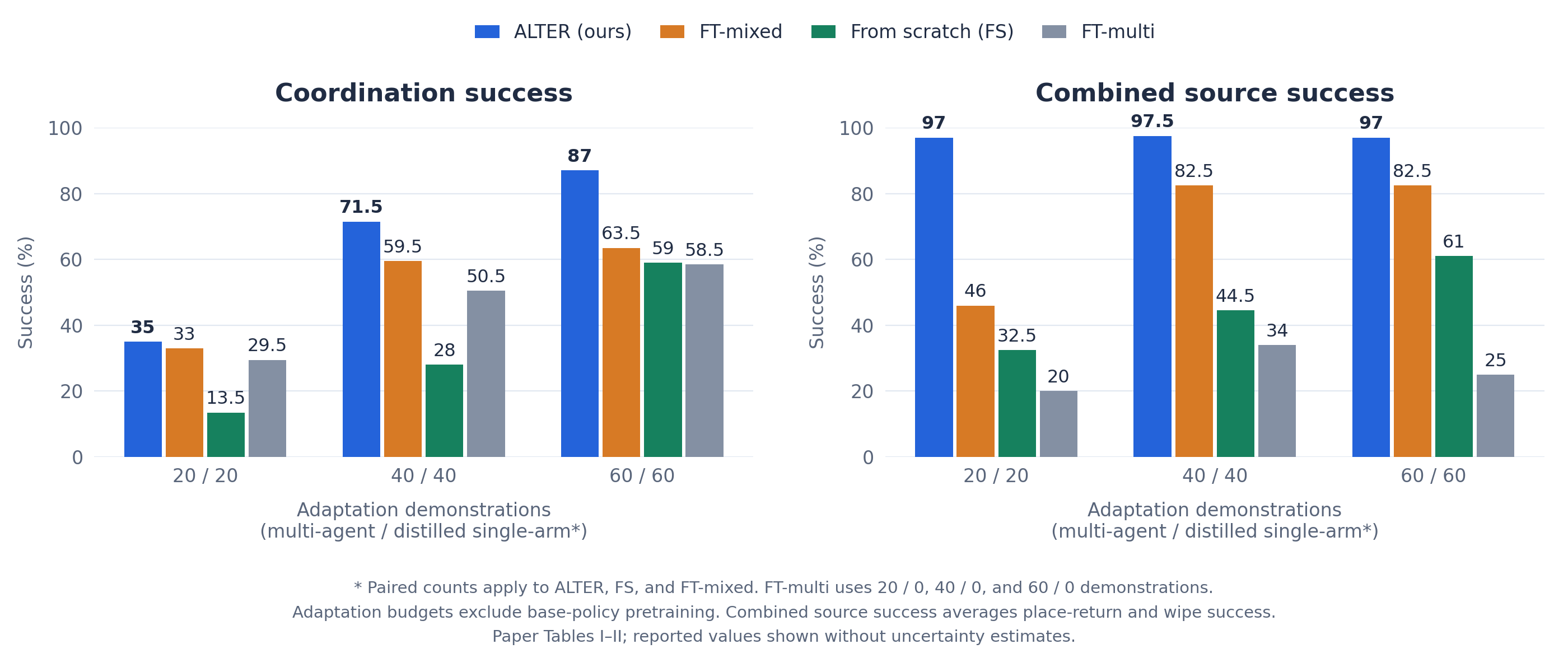
ALTER achieves the highest reported coordination success at each budget while retaining 97.0–97.5% combined source success. With 40 multi-agent and 40 distilled single-arm demonstrations, ALTER achieves 71.5% coordination success, exceeding FT-mixed (63.5%) and FS (59.0%) with 60 demonstrations of each type.
Hardware experiments
Two xArm7 robots coordinate to place a plush bird inside a lidded box. One robot removes the lid, the other places the bird, and the first replaces the lid. Each robot uses its own shoulder-view RGB camera.
Multi-agent coordination
Source-task retention
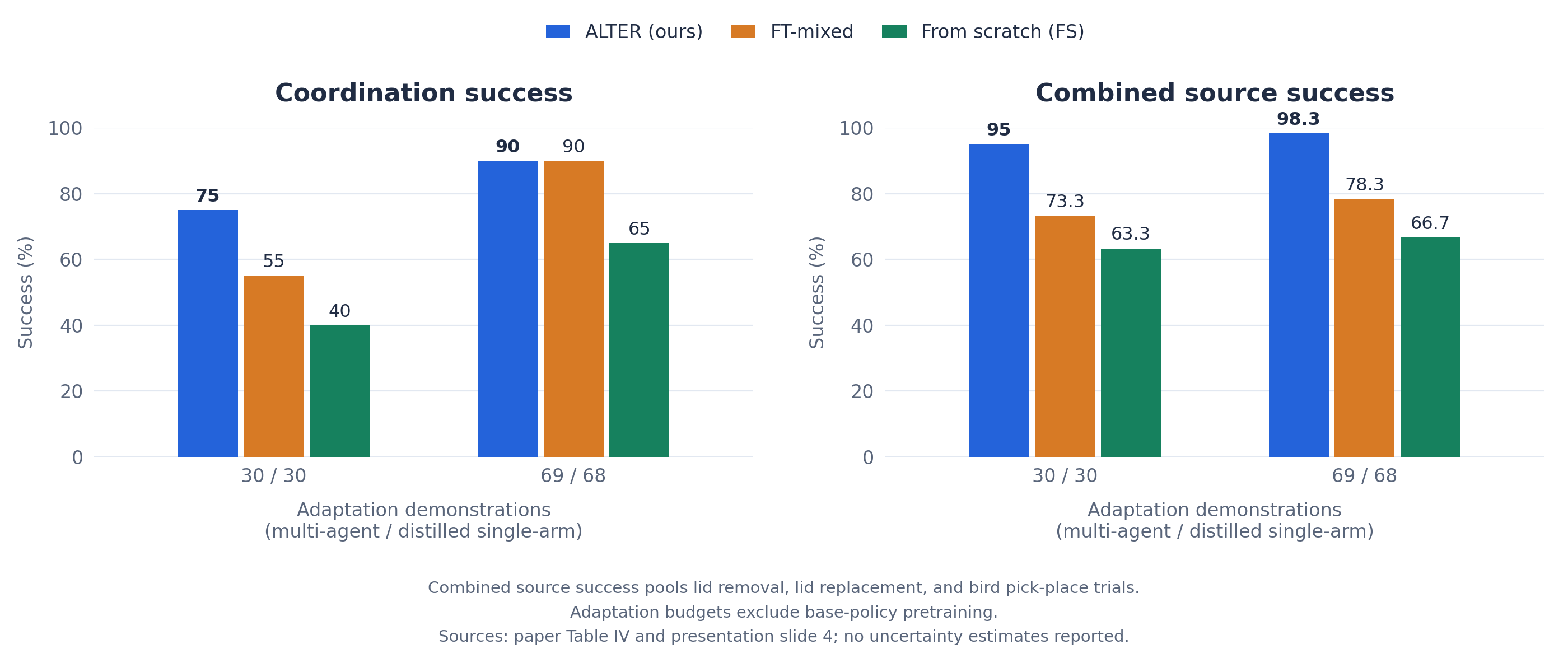
ALTER leads coordination in the lower-data regime and matches FT-mixed at the higher budget, while retaining 95–98.3% source-task success across both regimes.
Download data · Figure PDFEvaluation details and sources
Every method uses 30 / 30 or 69 / 68 multi-agent / distilled single-arm demonstrations, with 20 coordination trials and 60 source trials per regime. Combined source success pools lid removal, lid replacement, and bird pick-and-place; the higher-data evaluation uses 20 trials per task.
Higher-data results come from Table IV of the paper; lower-data results come from the presentation, “Hardware Results Across Data Regimes.”
Failures and near misses
Selected FT-mixed and FS trials illustrate failures and successful trials with nearly missed grasps or placements.
These qualitative examples are separate from the aggregate success rates in Table IV.
Citation
If you find ALTER useful in your research, please cite:
@article{dong2026alter,
  title={Residual Denoising Enables Sample-Efficient Multi-Agent Coordination on Demand},
  author={Dong, Dayi and Bhatt, Maulik and Shrivastava, Aayushi and Peters, Lasse and Mehr, Negar},
  journal={arXiv preprint arXiv:2609.32129},
  year={2026},
  url={https://arxiv.org/abs/2609.32129}
}
Acknowledgments
We thank NVIDIA for supporting this research through a compute grant.